

Anxiety and Depression
- Open Field Test
- Elevated Plus Maze Test
- Forced Swim Test
- Tail Suspension Test
- Sucrose Preference Test
Cognition
Epilepsy and Seizure
- Epilepsy and Seizure Behavioural Test
Drug Abuse Liability
Motor Function
- Open Field Test
- EMG recording during treadmill walking
- Narrow Beam Test
- Pole Climbing Test
- Rotarod Test
- Grip Strength Test
Peripheral Nerve Regeneration Test
EMG recording during treadmill walking
EMG patterns during treadmill walking are used for analyzing motor function activity of the mice after implantation and after pharmacological treatment.
Narrow Beam Test
The narrow beam walking test is used to assess fine motor coordination and balance in rodents. The goal of the beam walking test is for the rodent to stay upright and walk across the narrow beam to the platform within 2 minutes. Performance on the beam is evaluated by measuring the time it takes for the rodent to cross the beam and the speed of the subject. During the process, the activities of the rodent will be recorded by a camera and analyzed by video behavioural analysis software. This test is particularly used for detecting subtle deficits in motor skills and balance that may not be detected by other motor tests.
Pole Climbing Test
The pole climb test is widely used to assess basal ganglia-related movement disorders in mice. The test evaluates the ability of a mouse to grasp and maneuver on a pole in order to descend to its home cage.
Mice are trained to complete the pole test over three training trials and are placed with their head oriented upward on top of the pole. The time required for the animals to orient themselves facing in a downward direction (time to T turn) and to descend to the base of the pole (total time) is recorded for three trials. Recordings start when the animal begins the turning movement, and the footage will be analyzed by a specialized video behavioural analysis software.
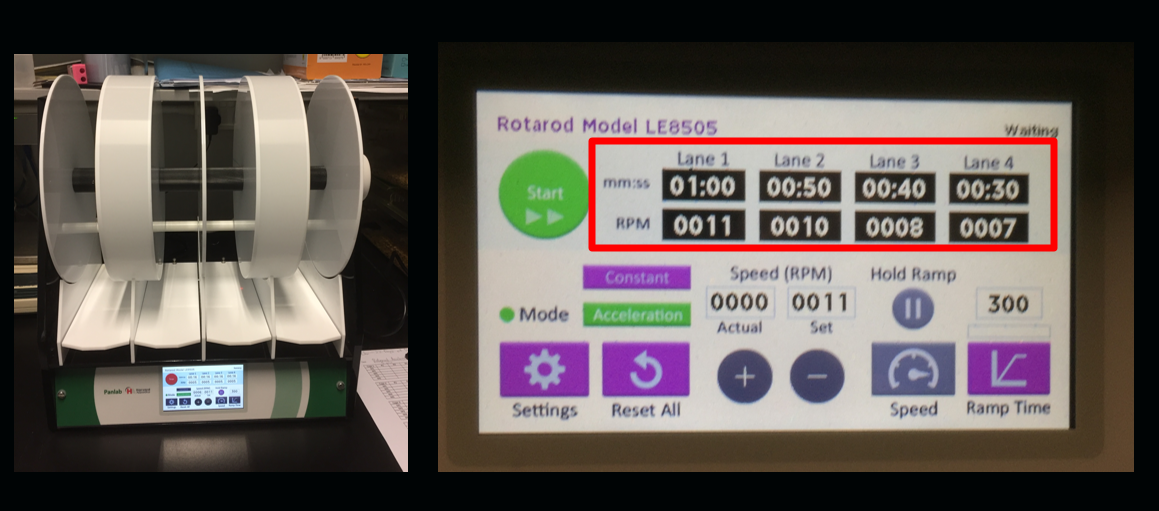
Rotarod Test
The rotarod test is widely used to evaluate the motor coordination of rodents, and is especially sensitive in detecting cerebellar dysfunction.
Open Field Test
The open field test allows the evaluation of an animal’s basal activity and its response to novelty or an anxiogenic environment.
Assessment takes place in a black Plexiglas box. The rodent is placed in the arena and allowed to freely move about for 10 minutes while being recorded by an overhead camera. The footage will then be analyzed and the following parameters will be measured: distance moved, velocity, and time spent in pre-defined zones. The open field test is useful for evaluating the effect of novel chemical entities on general activity.
Elevated Plus Maze Test
The elevated plus maze test is a widely used behavioural test for rodents to assess the anti-anxiety effects of pharmacological agents. Prescreening of newly developed pharmacological agents for the treatment of anxiety-related disorders can be carried out using the elevated plus maze test. Mice are placed at the junction of the four arms of the maze, facing an open arm, and their activities are recorded by a video-tracking system. An increase in open arm activity reflects anti-anxiety behaviour.
Forced Swim Test
The forced swim test (FST) is one of the most commonly used animal models for assessing antidepressant-like behaviour. The FST involves the scoring of active (swimming and climbing) or passive (immobility) behaviour when rodents are forced to swim in a cylinder with no escape. The FST can be used for the evaluation of antidepressant drugs, antidepressant efficacy of new compounds, and experimental manipulations that are aimed at rendering or preventing depressive-like states.
Tail Suspension Test
The tail-suspension test (TST) is a mouse behavioural test used in the screening of potential antidepressant drugs, and assessing other manipulations that are expected to affect depression related behaviours. In TST, mice are suspended by their tails with tape, in a position that prevents them from escaping or holding on to nearby surfaces. The resulting escape-oriented behaviours are quantified.
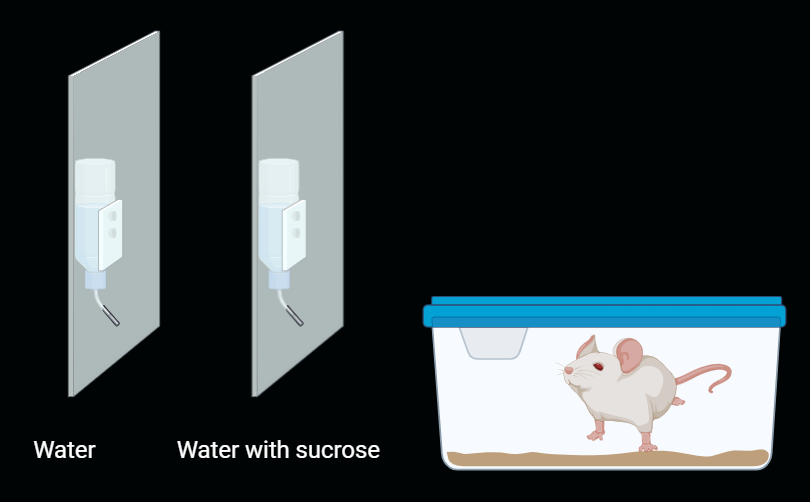
Sucrose Preference Test
Sucrose Preference Test (SPT) is a reward-based test which assesses the mouse’s interest in a sweet-tasting sucrose solution relative to pure water and is used as an indicator of anhedonia. Anhedonia is the inability to experience pleasure from rewarding or enjoyable activities, and is a hallmark symptom of depression in humans. SPF is recommended for the evaluation of depressive behaviours in depression studies and anhedonia in mice.
Morris Water Maze (MWM) Test
Morris Water maze test is a widely used test of spatial learning for rodents that relies on distal cues to navigate from start locations around the perimeter of an open swimming arena to locate a submerged escape platform. This test can be altered in different ways to investigate working memory, reference memory and task strategy. The use of the water maze test in assessing learning and memory has been reviewed as it has the relationship between performance in the test and both neurotransmitter systems and drug effects.
Barnes Maze Test
The Barnes-Maze test is a dry-land-based rodent behavioural paradigm for assessing spatial learning and memory. This test represents a well-established alternative to the water maze and offers the advantage of being free from the potentially confounding influence of swimming behaviour. It is useful for evaluating novel chemical entities for their effects on cognition and identifying cognitive deficits in transgenic strains of mice, especially those prone to anxiety.
Novel Object Recognition (NOR) Test
The Novel Object Recognition (NOR) task is used to evaluate cognition, particularly recognition memory, in rodent models of Central Nervous System (CNS) disorders. The amount of time taken to explore the novel object reflects the use of learning and recognition memory. This test is useful for assessing impaired cognitive ability in transgenic strains of mice and evaluating novel chemical entities for their effects on cognition.
Epilepsy and Seizure Behavioural Test
In experimental models of epilepsy, the Racine scale is often used to evaluate the stages of epileptic seizures in mice. With the aid of videos and EEG recordings, we can therefore establish which stages of epileptic seizures the mice are having after taking the drugs.